“Solid wood” and “veneer” describe construction details, not a verdict on an entire piece of furniture. Read the specification one part at a time: identify the material at the visible face, the panel or core behind it, the edges, the frame and the finish. A wood veneer is a real-wood facing bonded to a substrate; that substrate may be MDF, particleboard or plywood. The facing and the supporting panel are different parts of the description. Oakwood Veneer’s glossary defines veneer and substrate terms.
Neither label tells you everything about the piece’s construction or how it will suit your home. A clear component list lets you compare what is actually specified and ask focused questions about the rest.
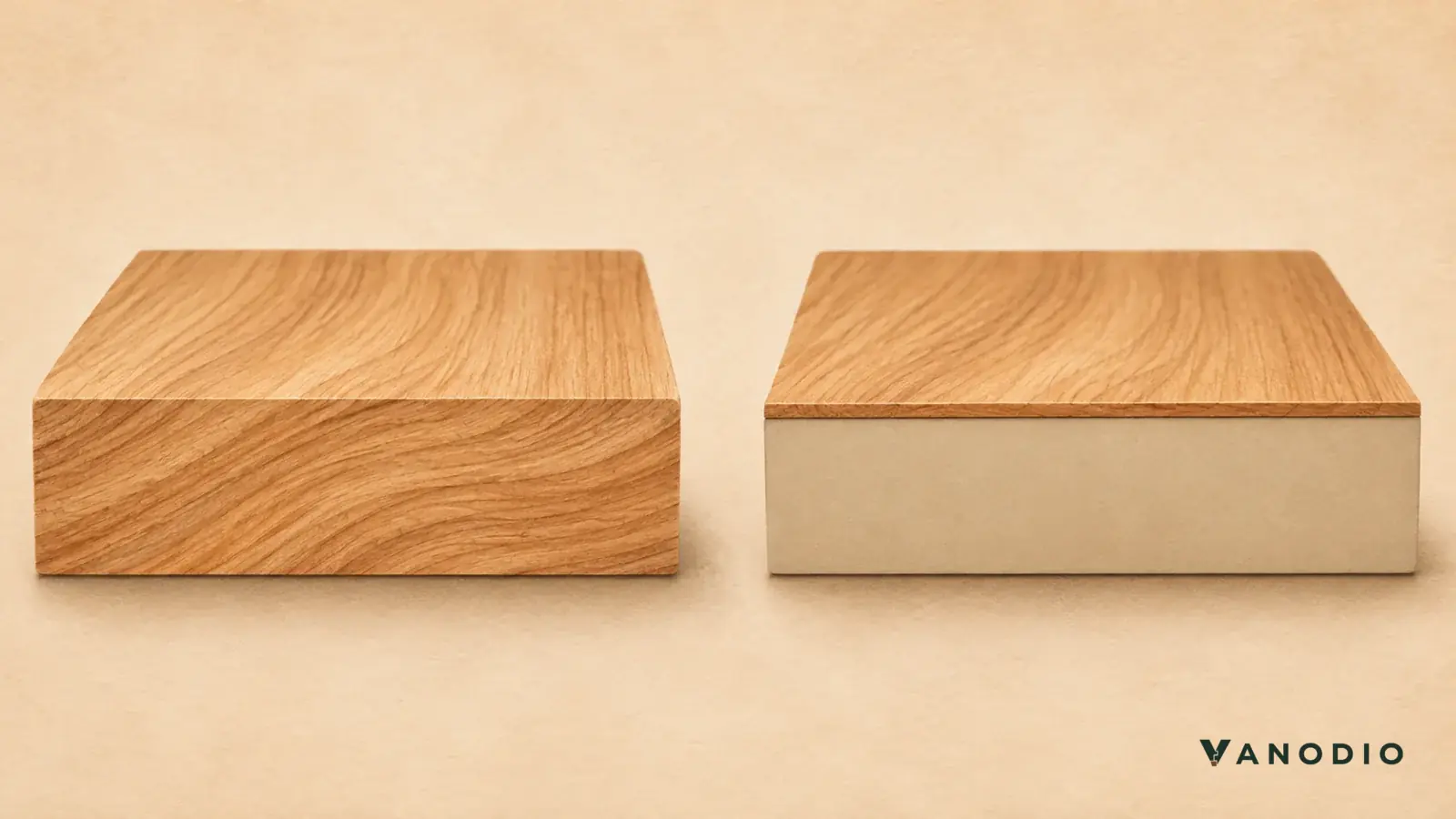
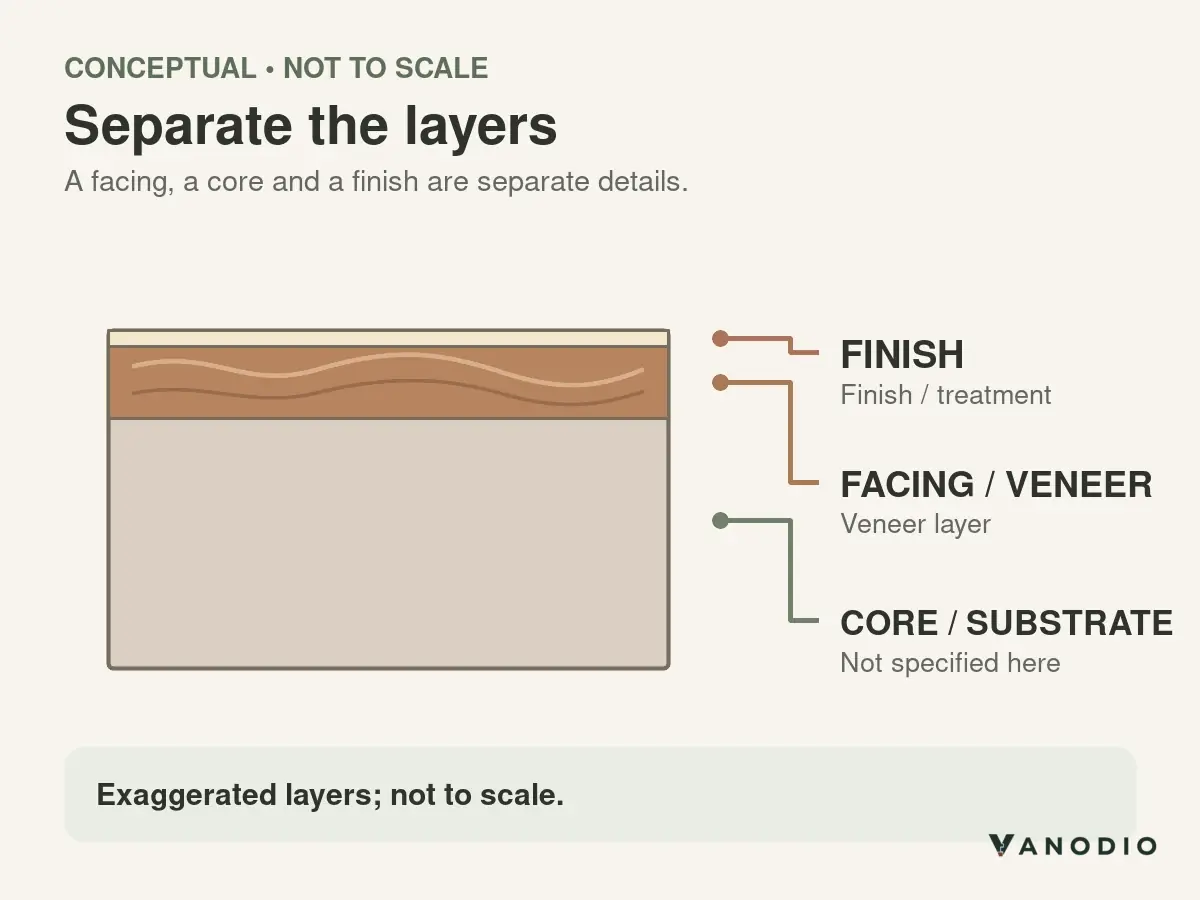
Conceptual comparison, not to scale; neither sample depicts a Vanodio product, and the panel substrate is not specified.
Start with the layers, then name the component
For this guide, a solid-wood component means a part made from solid lumber rather than a veneer-faced panel. Treat that as a practical distinction for reading a listing, not a legal definition. A veneer panel has at least two details worth separating:
- Facing: the thin wood surface you see. Ask which species is used if the listing names one.
- Core or substrate: the panel material supporting the facing. Ask what it is; “wood veneer” does not answer this by itself.
- Finish: the coating or treatment applied to a surface. It is a separate specification from both the facing and the core.
The word “wood” on a product page may describe one visible area, a veneer face, or a selected set of parts. It does not automatically describe every panel, edge, drawer or leg. A furniture maker’s construction overview, for example, names solid hardwood drawer parts and veneer panels for case backs in the same overview. That is a reminder to read each component separately, not a ranking of either construction or a description of a Vanodio product. See Copeland Furniture’s published component overview.
Build a component map
Begin with the parts the listing actually names. Use “not stated” when a detail is missing; do not fill a gap with an assumption based on the product photo or overall label.
| Part to check | What the description may tell you | What to ask when it is unclear |
|---|---|---|
| Top or main panel | Solid wood, wood veneer, or another named surface construction | Is the panel solid lumber throughout, or a wood facing over a core? If it is veneer, what are the facing species and core material? |
| Edge or band | A solid-wood edge, an applied strip, a wrapped facing, or no detail | Is the edge the same material as the face? How is it finished? |
| Legs and frame | A stated wood species or a general material label | Which parts are solid wood, and which use another construction? How are the parts joined? |
| Drawer fronts, sides and bottoms | Sometimes described separately, sometimes grouped as “drawers” | Are the front, sides and bottom made from the same material? Which details are specified? |
| Back, shelves and interior panels | May be omitted from a short headline | What is each panel made from, and does the same description apply to every shelf or back? |
| Finish and care | A finish name or a link to instructions may be provided | What care instructions apply to this exact surface and finish? |
This is not a grading scale. A clear specification helps you understand what you are buying; it does not by itself prove better joinery, longer service life or higher value. The material name, how parts are assembled and how surfaces are finished are separate questions.
Keep material, joinery and finish separate
A solid-wood part still needs a design that accommodates the way wood responds to its environment. Purdue Extension explains that wood takes on moisture in humid air and releases it in dry air, which can make it swell or shrink; finishes can slow that exchange but generally do not stop it. The useful takeaway is to ask how the maker designs and cares for the specific piece—not to conclude that solid wood is unsuitable or that veneer is immune to change. Purdue Extension’s furniture reference explains wood movement.
Joinery is another line in the specification. A wood species or veneer label does not tell you how a rail connects to a leg, how a panel is supported or whether a drawer uses a particular joint. If construction details matter to your decision, ask the maker to identify the joinery or provide a component description. Do not infer it from the surface grain.
Finish also deserves its own question. A photo can show color and visible grain, but it may not tell you what finish is present or what cleaning instructions apply. Ask for the care instructions for the exact item and finish. This guide does not recommend a cleaner, repair method or universal care routine.
What photos can—and cannot—tell you
A close view may help you see a grain pattern, a seam or an exposed edge. It cannot reliably identify a hidden core just because the front surface looks like a particular wood. That is a practical limit of what an ordinary product photo shows, not a test result.
Use photos to decide what to ask for next: a view of the underside, a clearly described edge, or a written specification for the panel. Then ask the seller or maker to confirm the construction in writing. If no answer is available, keep the field open rather than treating appearance as proof. There is no need to sand, scratch or damage a finished surface to make this comparison.
Two hypothetical listings, read part by part
These examples are invented for the worksheet. They are not Vanodio products, real listings, inspected samples or evidence about a particular maker.
Hypothetical listing A: “Solid walnut top; walnut veneer cabinet.”
This wording names a solid-wood top and a veneer-facing cabinet, but it leaves several details open. Does “top” include its edge? What core is under the cabinet veneer? Are the legs, shelves, drawer fronts and back covered by either phrase? What finish instructions apply? The description is a starting point for questions, not a complete component schedule.
Hypothetical listing B: “Walnut veneer over engineered wood.”
This names a veneer face and a broad core category, but “engineered wood” does not tell the buyer which panel material is used. It also does not say which parts receive the veneer, how the edges are finished, or what the frame and drawer components are made from. Ask for those specifics before comparing the listing with another piece.
Neither example is automatically better. The gaps matter because they keep you from knowing exactly which components the description covers.
Fill in a component-by-component worksheet
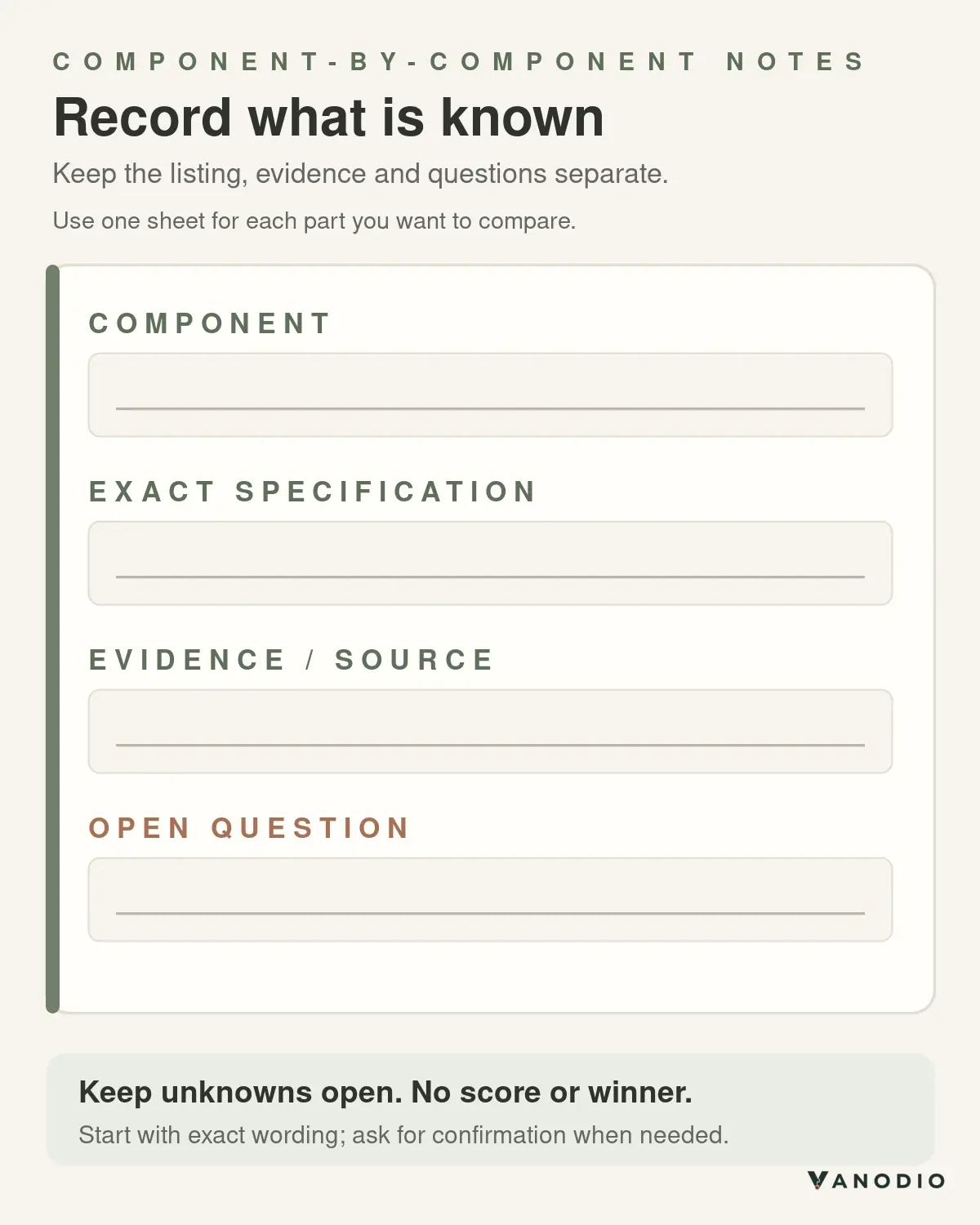
Copy this table when you are comparing two listings. Enter the exact wording first; then separate facts the seller confirms from questions still waiting for an answer.
| Component | Exact listing wording | Confirmed construction or finish | Evidence or source of confirmation | Open question |
|---|---|---|---|---|
| Top / main panel | __________________ | __________________ | __________________ | __________________ |
| Edge / band | __________________ | __________________ | __________________ | __________________ |
| Legs / frame | __________________ | __________________ | __________________ | __________________ |
| Drawer parts | __________________ | __________________ | __________________ | __________________ |
| Back / shelves / interior panels | __________________ | __________________ | __________________ | __________________ |
| Finish / care instructions | __________________ | __________________ | __________________ | __________________ |
Before you decide, review the unfinished rows and ask:
- Which parts are solid wood, and which have a wood veneer or another surface?
- For each veneered panel, what species is the facing and what material is the core?
- Are the edges, legs, drawer parts, backs and shelves included in the same description, or specified separately?
- What finish is used, and where are the care instructions for this exact item?
- Which joinery or assembly details can the maker confirm if they matter to your use?
If a seller answers only with another broad label, ask them to point to the component it describes. Record “not stated” until you have a specific answer.
Choose from verified details, not a material-name contest
If a particular species or solid construction matters to you, ask which component has it and how that part is built. If you are considering veneer, ask what the visible facing covers and how the rest of the piece is specified. Then compare those details with your priorities for appearance, intended use and care.
There is no universal winner in the words “solid wood” or “veneer.” Those terms alone do not establish price, durability, repairability, environmental impact, certification or the quality of a finished piece. Use the worksheet to identify what is known, ask about what is missing and make the choice only after you have enough information about the actual item.